Formulation
Botanical extract specifications: species, plant part and standardization

Editorial product illustration.
Botanical standardization is useful only when the specification names what is standardized and how it is measured. A purchasing line that says “premium extract” or gives an extract ratio does not define identity, potency, contamination risks or compatibility with an oral pouch.
Build an identity record
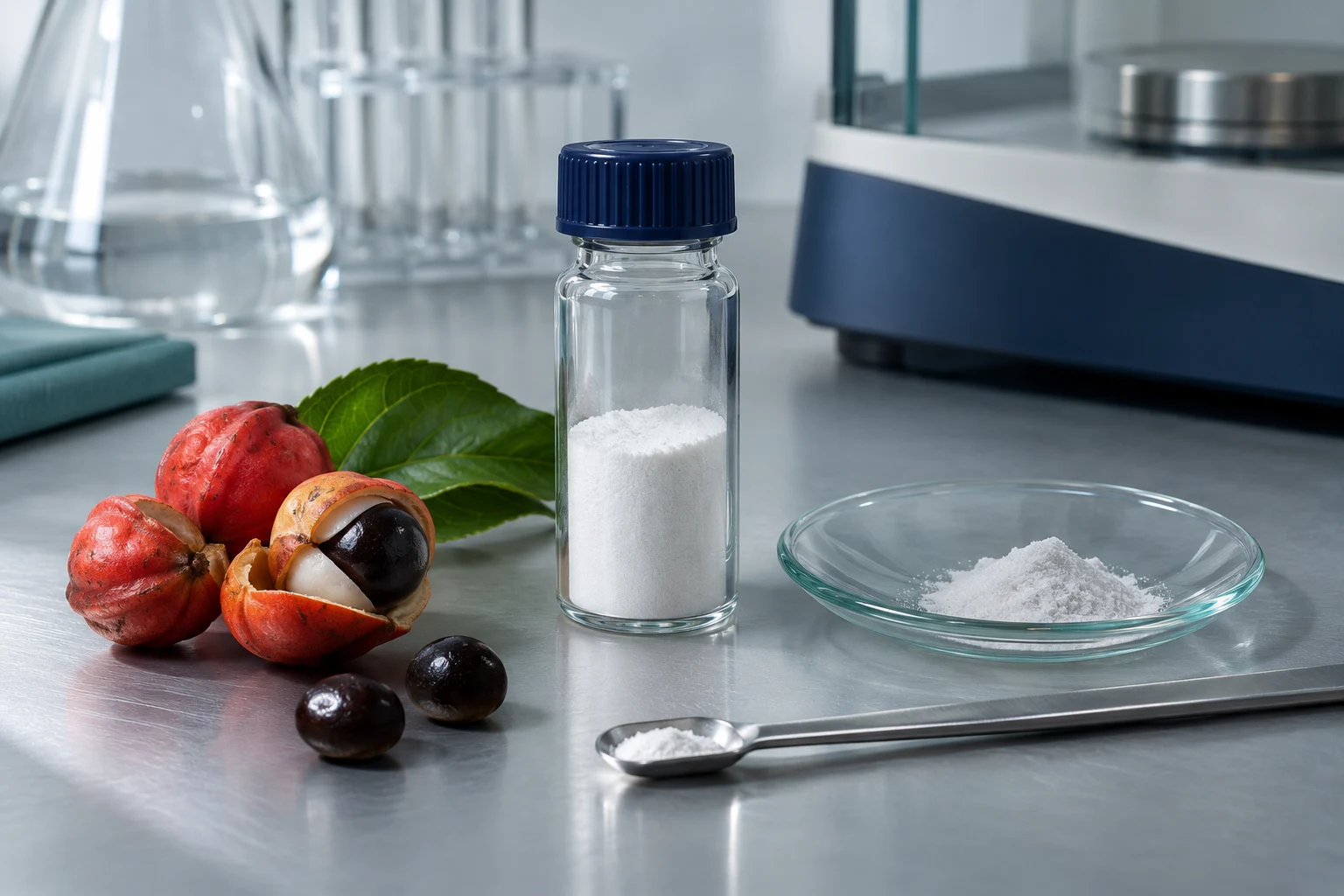
Record the scientific plant name, plant part, geographic or supply-chain information relevant to control, preparation type and supplier. Distinguish a powder from a dry extract and identify the extraction solvent or process where relevant. Maintain a link between the approved sample, the specification revision and the material used in production.
The identity method should fit the preparation. An approach suitable for intact leaves may not answer the same question in a highly processed extract. Ask the supplier and laboratory which features the method establishes and what its limitations are.
Read potency on a defined basis
Specify the marker or active, analytical procedure, reporting unit and basis. A result on a dry basis may not be directly comparable with a result on the material as supplied. Carrier additions and moisture also affect how much of a declared marker reaches the finished unit.
As an arithmetic illustration, a material described as containing ten percent of a marker does not consist entirely of that marker. The formulation calculation must account for the preparation’s measured potency and the amount incorporated. This is a specification exercise, not a recommended serving amount.
Set the contaminant review around the source
Consider microbial quality, relevant elemental contaminants, pesticides, residual solvents and adulteration risks according to the botanical and process. A generic panel can omit a material-specific concern. Where US supplement CGMP applies, specifications and the basis of appropriate testing are part of the manufacturer’s quality obligations. [1]
A COA should identify the batch and methods rather than reporting a row of unqualified “pass” statements. For important results, agree what supporting information the buyer can obtain and how out-of-specification findings or supplier changes will be handled.
Check whether the studied preparation matches
Different plant parts and extracts should not inherit the same clinical interpretation merely because the common plant name matches. NCCIH’s discussion of ashwagandha highlights variation in preparations and limitations in the evidence. [2] Apply that discipline when reviewing any botanical claim.
- Identity and the preparation’s complete composition.
- Marker definition, method and potency basis.
- Contaminant risks and a justified test panel.
- Pouch compatibility, taste and analytical recovery.
- Evidence relevant to the specific preparation and intended use.
Questions buyers ask
Does a 10:1 extract mean ten times the clinical effect?
No. A manufacturing ratio does not establish a dose-response relationship or equivalence to a preparation used in a study.
Can two COAs be compared when one says dry basis?
Only after reconciling the reporting bases and methods. Ask for the moisture information and the definitions needed to make a meaningful comparison.
Can an extract supplier change without changing the ingredient list?
The label might look unchanged while the underlying preparation differs. Use change control to assess identity, potency, carriers, contaminants, sensory behavior and stability.
Explore the product specifications
Sources & further reading
- FDA: Dietary Supplement CGMP Small Entity Compliance Guide
- NCCIH: Ashwagandha — Usefulness and Safety
Sources checked November 7, 2026. External research and guidance are context; they are not test results or authorizations for a Sunova finished product.
Prepared by Sunova Pouches Editorial for B2B product development. Content is reviewed for sourcing and claim scope; it does not establish finished-product efficacy or market authorization.
Our editorial policy