Formulation
Cellulose carriers and fill weight: designing a comfortable, consistent pouch
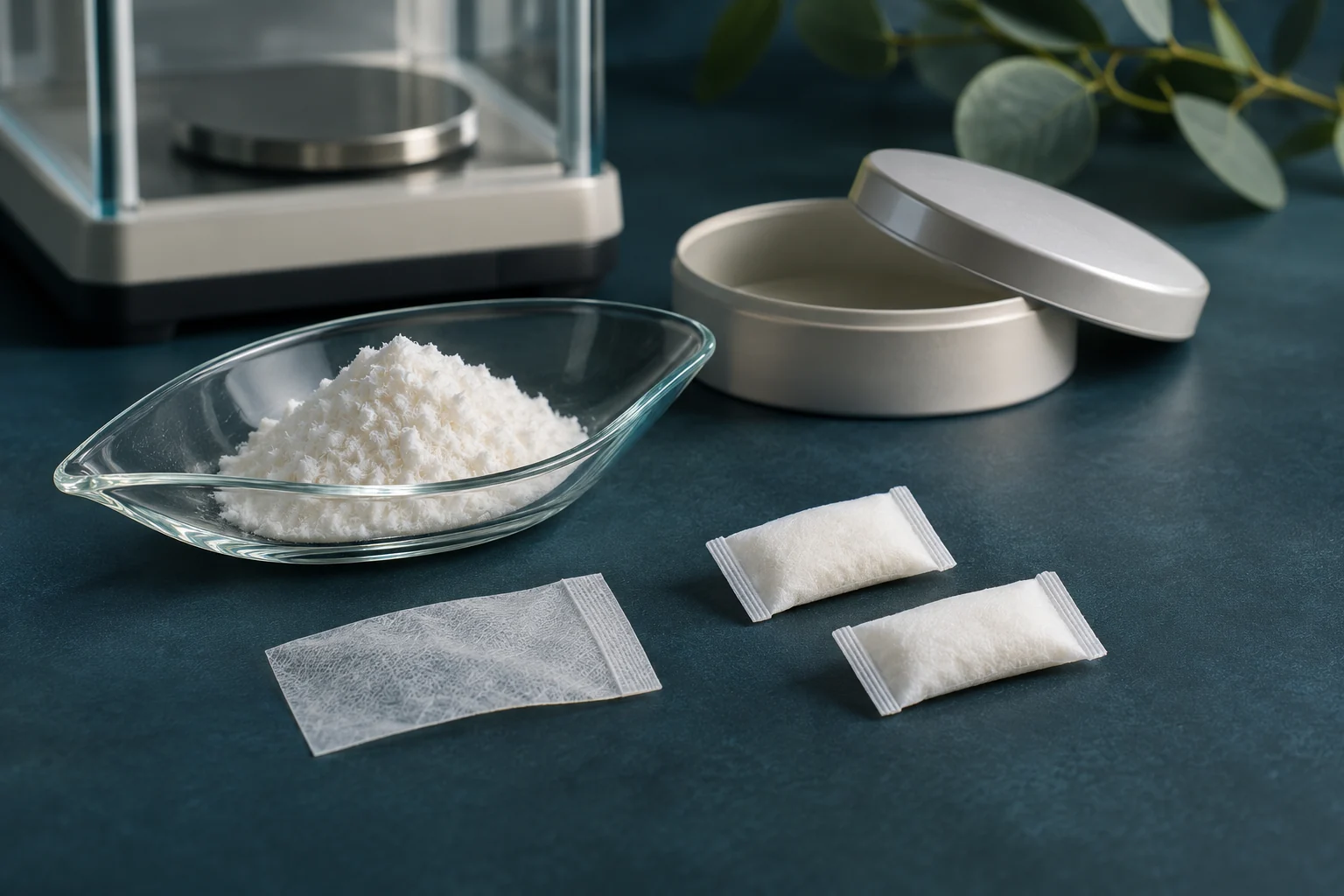
Editorial product illustration.
The carrier is a large part of an oral pouch’s physical behavior. Microcrystalline cellulose, other plant-fiber preparations and their mixtures can differ in density, particle structure and liquid handling. Selecting a carrier by its generic name leaves important production and sensory variables uncontrolled.
Review the actual grade
Obtain the material’s identity, grade, particle-size information, bulk-density data, moisture specification and relevant quality documents. Ask how the material is supplied and stored. A supplier change can alter performance even when the ingredient list still says cellulose.
Evaluate the carrier with the active ingredients, flavor and moisture system that the project will use. Raw-material handling observations should be connected to finished-pouch results. A carrier that flows well alone may behave differently after a liquid flavor or humectant is incorporated.
Connect fill weight to pouch volume
Two blends with the same mass can occupy different volumes. Pouch dimensions, packing density and the filling process therefore need to be considered together. A can’s nominal capacity does not establish how many finished pouches it will hold comfortably.
Define the finished-unit weight and its acceptance criteria, then examine the resulting shape and feel. Too little usable space can stress the web or interfere with sealing; changing the pouch size can alter the product experience and the number of units that fit in the can. Approve a physical sample and the relevant drawing revision.
Check distribution and retention
Differences between carrier and active particles can affect segregation during handling. Review sampling through the blend and throughout filling, particularly after transport or a production pause. A consistent fill weight does not prove consistent active content when the blend itself is uneven.
Also inspect what the nonwoven retains. Very fine material, broken seals or an unsuitable web can lead to leakage or a gritty experience. Diagnose the observed failure using the actual blend, web and process rather than assuming every problem is caused by the carrier.
Control the material in the quality system
For a project within US dietary supplement requirements, the applicable CGMP framework includes specifications for components and controls supporting the quality of the finished product. [1] The carrier should be treated as a controlled input alongside the actives and packaging.
- Approved identity and material-grade specification.
- Particle, density and moisture characteristics relevant to the process.
- Blend distribution and finished-unit active consistency.
- Fill-weight capability, shape and sensory acceptance.
- Compatibility with the web, seal and final package.
Keep retained material and finished samples when a grade or supplier changes. Comparing those samples can help explain a later shift in flow, pouch fullness or texture. A written change record is more useful than trying to reconstruct which material was used from an ingredient name alone.
Questions buyers ask
Will the same fill weight create the same pouch size with every carrier?
No. Blend density and processing affect occupied volume. Confirm the result with the actual formulation and filling setup.
Does a heavier pouch contain more active ingredient?
Not necessarily. Fill weight includes the whole blend. Active content requires its own specified amount, distribution controls and suitable assay.
Can the carrier be changed after flavor approval?
It should go through change control. The change can affect sensory performance, flow, distribution, moisture behavior and package compatibility.
Explore the product specifications
Sources & further reading
Sources checked November 7, 2026. External research and guidance are context; they are not test results or authorizations for a Sunova finished product.
Prepared by Sunova Pouches Editorial for B2B product development. Content is reviewed for sourcing and claim scope; it does not establish finished-product efficacy or market authorization.
Our editorial policy