Oral films
Oral film thickness and dose uniformity: map the cast sheet and cut units
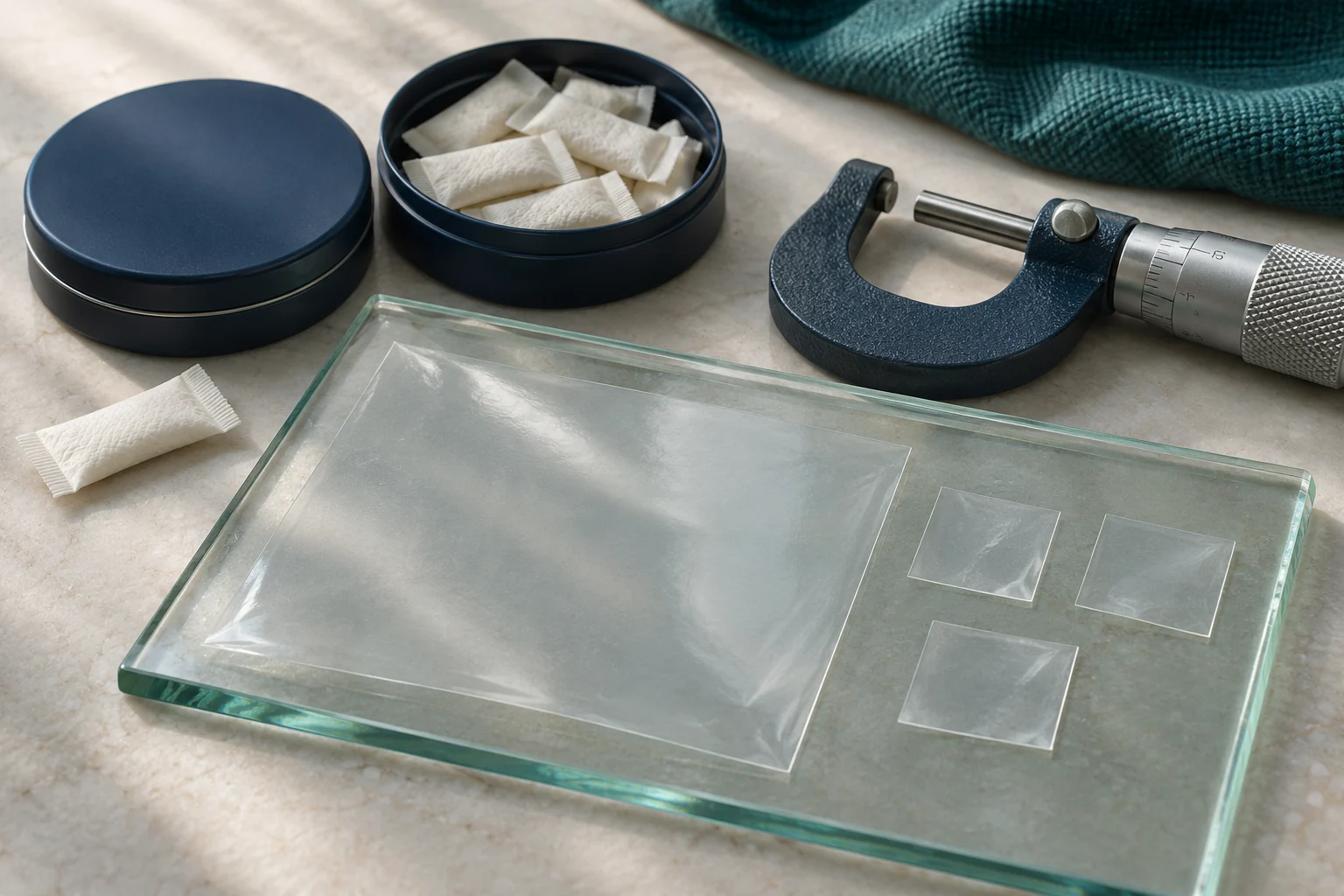
Editorial product illustration.
A uniform-looking sheet is a useful observation, but it does not establish equal active content in every cut strip. An oral-film control plan should connect formulation distribution, cast-sheet geometry and the finished unit’s analytical result.
Map the cast sheet
Define sampling positions across the usable width and along the casting direction. Record edge exclusions, coating conditions, drying history and cutting coordinates. A center-only sample can miss variation near an edge or during the beginning and end of a run.
For a suspension, investigate whether particles remain distributed during the relevant holding and casting time. For a solution, drying and migration can still influence the final system. State how the casting feed is controlled and when it may be used.
Understand what thickness and weight can show
Thickness and unit weight can help monitor a repeatable process. Their relationship to active content must be demonstrated for the formula. Similar dimensions cannot compensate for uneven active distribution.
Specify the measuring method and locations. A film may compress under a measuring device, and residual moisture can affect both mass and dimensions. Keep conditioning and handling consistent when comparing batches.
Measure finished-unit content
Use an analytical method suitable for the active in the film matrix. Define extraction, sampling and reporting on the same unit basis as the specification. Distinguish individual-strip results from a pooled average.
Original unit-dose film research demonstrates that preparation and process control matter to dosing accuracy. [1] It does not create one acceptance range for all oral films. Establish criteria appropriate to the product category, destination and technical risk assessment.
Create a traceable approval record
- Formula version and raw-material lots.
- Casting feed preparation, holding time and process conditions.
- Sheet-position map with thickness, weight and assay results.
- Cutting dimensions and the treatment of nonconforming areas.
- Investigation of trends, deviations and failed samples.
- Stability results for the final packed units.
Approval should consider the pattern of results as well as whether individual values meet limits. A trend can reveal a process problem before it produces a clear failure. Changes in scale, coating system or cutting layout deserve an impact assessment.
Questions buyers ask
Can equal strip weight replace assay testing?
Not without an appropriate, demonstrated relationship and justified control strategy. Weight alone does not directly measure the active.
Can a consumer cut a strip in half for half the active?
That assumption requires evidence about distribution and the approved instructions. A separate controlled strength is preferable to an unsupported cutting instruction.
Does a passing laboratory sheet prove commercial consistency?
No. Commercial casting, drying, cutting and packing must be assessed at the intended process scale with a representative sampling plan.
Explore the product specifications
Sources & further reading
Sources checked November 7, 2026. External research and guidance are context; they are not test results or authorizations for a Sunova finished product.
Prepared by Sunova Pouches Editorial for B2B product development. Content is reviewed for sourcing and claim scope; it does not establish finished-product efficacy or market authorization.
Our editorial policy