Formulation
Caffeine and guarana: specify the assay
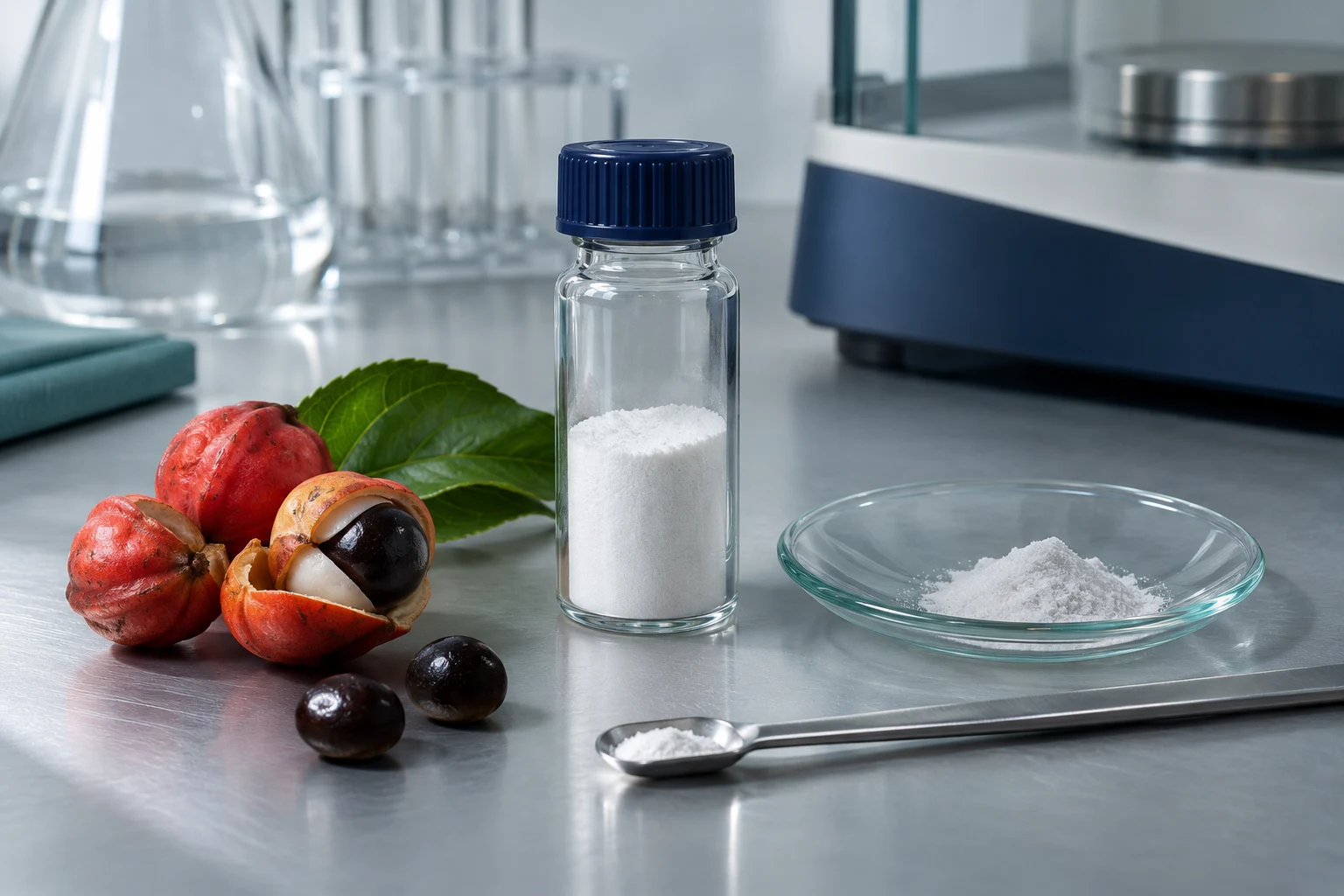
A guarana extract weight is not a caffeine amount. The difference becomes commercially important when a pouch contains guarana, green tea or coffee alongside added caffeine. A clear specification counts every source and states how the finished amount will be measured.
Calculate from the raw-material assay
For each caffeine-bearing ingredient, multiply the amount included per pouch by its measured caffeine fraction. Add the contributions from all sources. For example, a hypothetical 100 mg extract assayed at 10% caffeine contributes 10 mg caffeine before manufacturing variability is considered. The example illustrates arithmetic; it is not a recommended dose or a product specification.
Use the actual supplier specification and certificate of analysis. If an extract is only described as “guarana 10:1,” the extraction ratio does not provide the caffeine assay. Ask for the assay method, limits and representative batch data.
Keep the units explicit
- Extract inclusion: mg of ingredient per pouch.
- Assay: percentage by mass of caffeine in that ingredient.
- Caffeine contribution: mg of caffeine per pouch.
- Finished specification: target and acceptable range, supported by sampling and testing.
A blend calculation needs a finished-product check
A spreadsheet cannot detect segregation, inaccurate dispensing or uneven fill. Development should confirm that the analytical method works in the actual matrix and that representative samples meet the finished specification. A caffeine assay validated for a drink cannot automatically be assumed suitable for a fiber-based pouch.
Ask the laboratory about extraction recovery, specificity, precision and the sample preparation procedure. Define whether the reported result is per gram of blend, per pouch or per can. Those results are not interchangeable without the relevant weight data.
Botanical origin does not establish release behavior
Guarana and green coffee can offer a botanical ingredient story, but their source does not prove a slow-release profile, a fixed duration or the absence of unwanted effects. Those claims require evidence from the finished product under the intended conditions of use.
L-theanine can be explored as part of a caffeine formulation, but a 1:1 or 2:1 ratio is a design choice. A ratio does not guarantee a cognitive outcome or cancel the risks associated with caffeine exposure.
Use general safety data within its scope
EFSA’s assessment of caffeine in the general healthy adult population addresses intake from all sources. Its published conclusions include single amounts up to 200 mg and daily intake up to 400 mg under the conditions described in the assessment. These figures are not oral-pouch dose recommendations, local legal limits or validation of buccal exposure. Different populations and conditions require separate consideration.
The practical development question is how the final product will be classified, labeled and used in its destination market. Avoid translating general food-intake guidance directly into a high-strength pouch.
A buyer’s caffeine checklist
- Identify every caffeine-bearing ingredient and its batch assay.
- Calculate the total contribution in consistent units.
- Agree blend uniformity and fill-weight controls.
- Verify the finished matrix with a suitable analytical method.
- Review directions, warnings, classification and claims for the destination market.
Questions buyers ask
Does “natural caffeine” mean caffeine-free?
No. Botanical sources can contribute caffeine and must be counted.
Can a supplier’s extract certificate replace finished testing?
It supports the input calculation. It does not show that the final blend and filling process deliver the intended amount consistently.
Should coffee flavor be counted as caffeine?
Check the actual ingredient specification. A flavor name alone does not establish whether it contributes caffeine.
Reference
EFSA: Caffeine. Consult the original assessment for its populations, assumptions and limits.
Prepared by Sunova Pouches Editorial for B2B product development. Content is reviewed for sourcing and claim scope; it does not establish finished-product efficacy or market authorization.
Our editorial policy