Product development
Coffee and guarana pouches: account for every source of caffeine
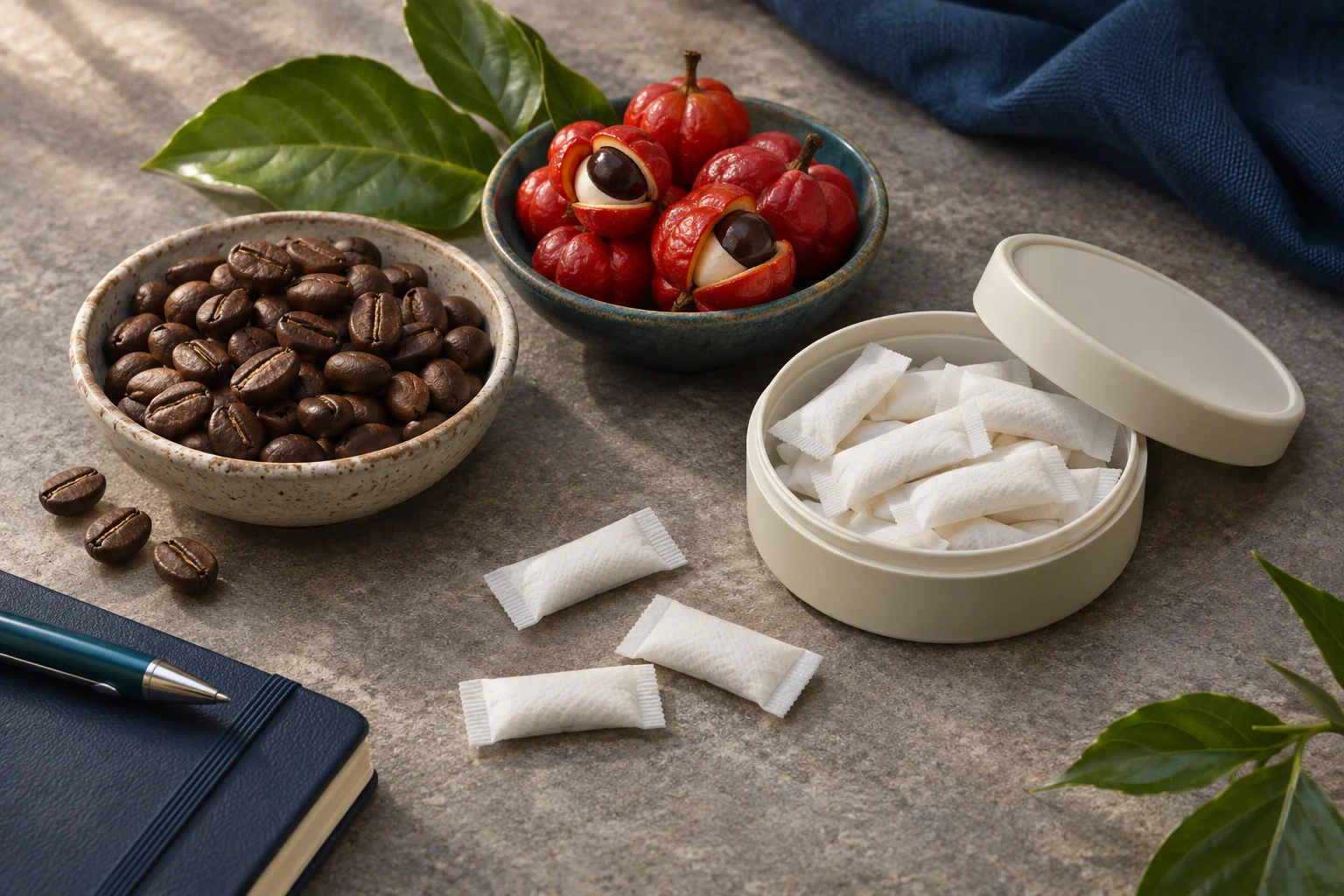
Editorial product illustration.
Coffee and guarana bring more than a flavor name to a pouch. Depending on the material selected, they can contribute caffeine, color, particles, oils and a characteristic aftertaste. A clear brief distinguishes a coffee-style flavor from a coffee ingredient and identifies whether guarana is present as seed powder or an extract.
Count caffeine from every input
Start with the supplier’s identity and assay for each caffeinated material. A botanical ingredient’s mass is not the same as its caffeine contribution. Added caffeine, coffee-derived caffeine and guarana-derived caffeine must be considered together when specifying total caffeine per pouch.
The worksheet should record the material’s potency basis, the amount used, its contribution to the finished unit and the analytical uncertainty. Reconcile that calculation with finished-product testing. FDA’s consumer guidance also stresses considering caffeine across foods, beverages and supplements; the source of the caffeine does not remove the need to assess total exposure. [1]
Choose the material for the product you intend
A finely divided botanical powder, a soluble extract and a flavor concentrate behave differently during blending and filling. Ask about particle size, bulk density, solubility or dispersibility, moisture and any carrier used in an extract. An extract ratio alone cannot describe the whole material.
A pouch intended to show a gentle coffee aroma may use a different ingredient strategy from one designed around a distinct roasted-coffee character. Dark ingredients can affect the appearance of the pouch and the mouth-contact liquid. Decide which changes are acceptable before sampling, rather than rejecting the natural appearance after the formula has been developed.
Test the pouch and its package together
Botanical oils and volatile aroma components can interact with carriers, the nonwoven web and packaging. Compare the approved sample with retained samples stored in the final can. Record aroma on opening, bitterness, texture, visible staining, seal condition and active recovery. A good first-day coffee aroma cannot establish performance at the end of shelf life.
- Specify the botanical name, plant part and processing form.
- Identify extract carriers and relevant residual solvents or contaminants.
- Set total caffeine per finished pouch and the verification method.
- Review particle behavior, staining and pouch seam cleanliness.
- Include flavor and caffeine in the stability protocol.
The applicable manufacturing controls depend on classification. Where US dietary supplement CGMP requirements apply, specifications and the basis for ingredient and finished-product controls are part of the quality system. [2]
Keep “natural” claims specific
Calling an ingredient natural does not establish a safer finished product or a different caffeine effect. Origin claims, flavor descriptions and health claims require different evidence. Ask which statement will appear on the label and retain the documents supporting that exact statement. FTC guidance requires health-related advertising to be truthful and supported by appropriate evidence. [3]
Questions buyers ask
Is a coffee-flavored pouch always caffeinated?
No. A flavor direction and a caffeine specification are separate choices. Confirm the actual ingredient composition and total caffeine result rather than inferring either from the product name.
Can guarana replace added caffeine one-for-one?
Not by raw-material weight. Its caffeine potency and its other constituents must be considered. A reformulation requires a new mass balance, sensory evaluation and appropriate verification.
Why did a botanical pouch change color during storage?
Possible contributors include the botanical itself, moisture, oxygen, ingredient interactions and packaging. Compare retained samples and relevant analytical results before deciding whether a change is acceptable.
Explore the product specifications
Sources & further reading
- FDA: Spilling the Beans — How Much Caffeine is Too Much?
- FDA: Dietary Supplement CGMP Small Entity Compliance Guide
- FTC: Health Products Compliance Guidance
Sources checked November 7, 2026. External research and guidance are context; they are not test results or authorizations for a Sunova finished product.
Prepared by Sunova Pouches Editorial for B2B product development. Content is reviewed for sourcing and claim scope; it does not establish finished-product efficacy or market authorization.
Our editorial policy