Product development
Mushroom pouches: species, extraction and beta-glucan specifications
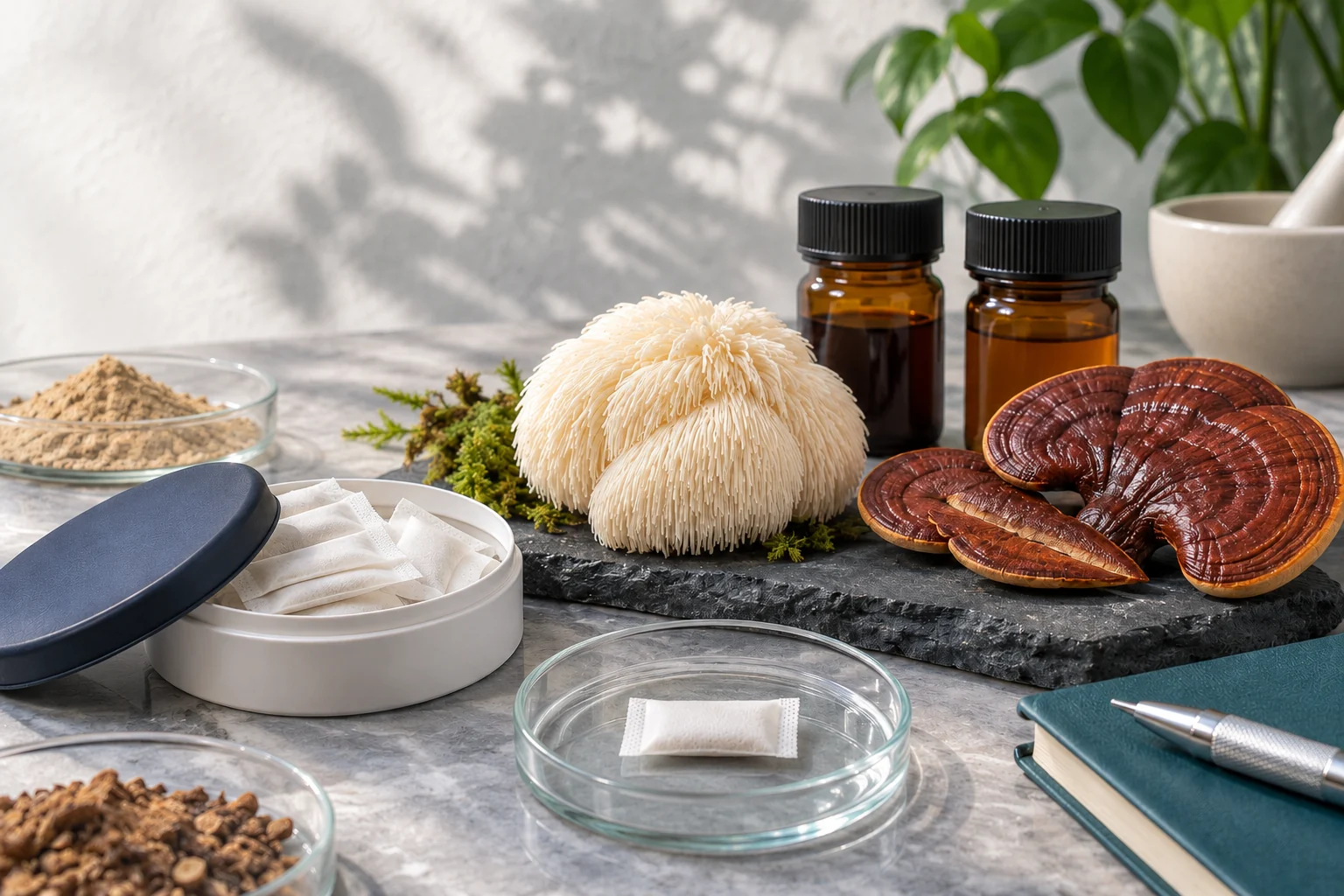
Editorial product illustration.
A mushroom pouch specification should describe the material more precisely than “mushroom extract.” Species, source tissue, cultivation substrate, extraction process and analytical markers can all change what is being purchased. These details also affect taste, fill behavior and the evidence that can reasonably support a product statement.
Identify the material being supplied
Request the scientific species name and the part or preparation used: fruiting body, mycelium, myceliated substrate or an identified extract. Record the supplier and manufacturing process. A photograph of lion’s mane or reishi does not establish the identity or composition of a powder.
Extract ratios need context. A ratio can describe a manufacturing relationship while saying little about the final carrier content or marker concentration. Obtain the full specification and the test method for any declared marker, then confirm which parts of the preparation contribute to the finished pouch mass.
Ask what the carbohydrate result measures
A specification for “polysaccharides” should not automatically be rewritten as a beta-glucan specification. The analyte and analytical method need to match the claim. Ask the laboratory to explain the method’s scope, potential interferences and reporting basis for the supplied material and the finished product.
This is especially important when carriers or cultivation substrates can contribute carbohydrates. A buyer comparing two certificates should first check whether the reported values describe the same analyte on the same basis. A higher percentage is not inherently a better result when the methods are different.
Evaluate contamination and sensory constraints
Build a risk-based panel for the source and intended use. Review relevant microbial quality, elemental contaminants and any process-specific residues. The FDA dietary supplement CGMP guide explains the need for appropriate specifications and quality controls where that framework applies. [1]
In the pouch, assess particle feel, color transfer, bitterness, aroma and changes after storage. An extract that performs well in a capsule may have a difficult mouth-contact profile. Confirm the intended pouch dimensions, fill weight and carrier system before selecting the commercial material.
Keep research and advertising connected
Evidence for one species, preparation or administration method should not be generalized to every mushroom pouch. Identify the exact benefit that a label or website would communicate and assess whether the evidence supports that statement for the proposed product. FTC guidance addresses both express and implied health claims. [2]
- Species, source material and preparation identity.
- Extraction process, carriers and potency basis.
- Specific marker, analytical method and reporting unit.
- Contaminant controls appropriate to the source.
- Finished-pouch sensory, assay and stability acceptance.
Questions buyers ask
Does a higher extract ratio prove a stronger pouch?
No. The ratio needs to be read alongside composition, marker specifications, analytical methods and the amount in the finished unit.
Can a total-polysaccharide result support a beta-glucan claim?
Only if the test and result actually establish the claimed analyte. Confirm the analytical scope instead of changing the terminology on the label.
Does adding lion’s mane substantiate a focus claim?
The ingredient name alone does not. Review evidence for the specific preparation, intended conditions and finished-product claim.
Explore the product specifications
Sources & further reading
Sources checked November 7, 2026. External research and guidance are context; they are not test results or authorizations for a Sunova finished product.
Prepared by Sunova Pouches Editorial for B2B product development. Content is reviewed for sourcing and claim scope; it does not establish finished-product efficacy or market authorization.
Our editorial policy