Formats & materials
Pressed-edge and ultrasonic pouch sealing: choose the process with test evidence
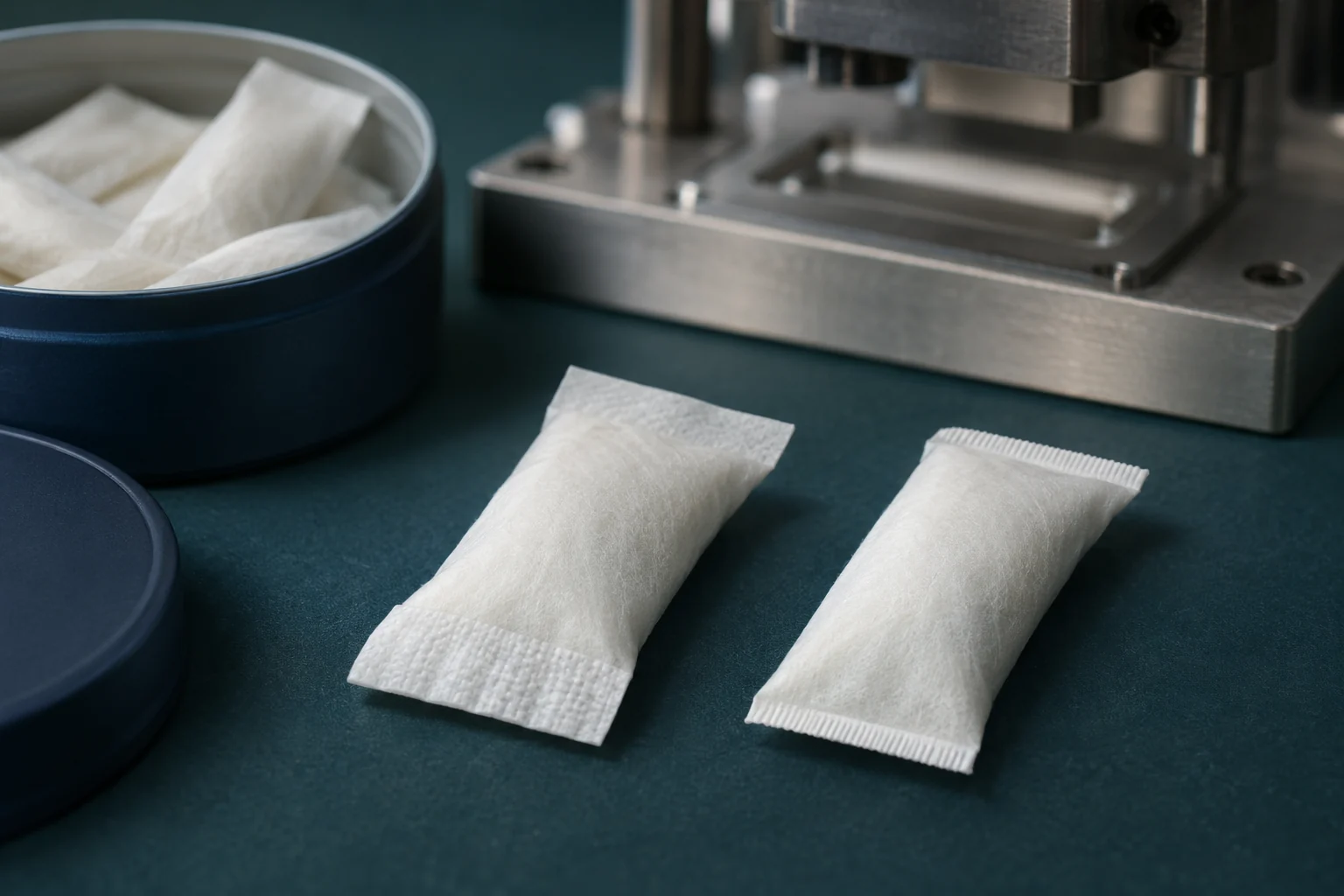
Editorial product illustration.
Pressed-edge and ultrasonic sealing describe process options, not a ranking of finished-pouch quality. A seam is useful when it consistently holds the actual blend in the selected web while preserving the intended pouch dimensions and comfort. Choose the process with material compatibility and performance evidence.
Describe what the process actually does
Ask the manufacturer to identify the web, its sealable components and the operating principle of the proposed process. “Pressed” can be used loosely in commercial discussions, so clarify whether heat, pressure or another process is involved. An ultrasonic process also requires a suitable material and a controlled setup.
Do not infer that a process name means chemical-free, plastic-free or suitable for every formulation. Those are different questions. Composition and contact suitability need the relevant material records and use assessment. [1]
Evaluate seams made with the commercial blend
Material at the seal zone can change how a seam forms. Test the pouch containing the actual powder or moist blend, not only an empty web sample. Review whether filling creates particles, oils or moisture at the joining area and whether that effect changes during a production run.
Inspect seam width, continuity, alignment and pouch dimensions. Assess whether the seam creates a stiff or sharp-feeling region and whether it remains intact under the handling relevant to the product. A tidy photograph of one seam does not establish process consistency.
Define the test before agreeing a pass limit
If seal strength is measured, document the specimen preparation, conditioning, pull direction, grip arrangement and test settings. Results from different procedures may not be comparable. Record the failure mode as well as the force: a web tear and a seam opening can describe different performance.
- Material and supplier revision used for the test.
- Filled-pouch condition, sample age and storage history.
- Defined mechanical test method and failure description.
- Visual integrity, particle leakage and relevant use-condition checks.
- Sampling across the pilot and production run.
Approve a process window
Development should establish which settings and material conditions produce acceptable pouches, and how those settings will be monitored. A single successful sample does not show that a process remains controlled through a full batch. Relevant equipment, material and manufacturing records support the handover.
Where supplement CGMP applies, the quality framework includes specifications, production controls and records. [2] Translate the approved prototype into usable manufacturing instructions and agreed in-process checks. Revisit the assessment when web, blend or equipment changes.
Questions buyers ask
Is ultrasonic sealing always better than a pressed seam?
No. Suitability depends on the web, blend, process capability and finished-product requirements. Compare evidence from the actual proposed configurations.
Does a narrow seam prove that a pouch is more comfortable?
It is one feature to evaluate. Seam stiffness, edge condition, pouch dimensions and material behavior can also affect the experience.
Can an empty-web seal test approve the filled product?
It is useful early information, but filling can introduce conditions that affect joining and integrity. Include commercial-blend samples and appropriate pilot-run checks.
Explore the product specifications
Sources & further reading
- FDA: Food Ingredient and Packaging Inventories
- FDA: Dietary Supplement CGMP Small Entity Compliance Guide
Sources checked November 7, 2026. External research and guidance are context; they are not test results or authorizations for a Sunova finished product.
Prepared by Sunova Pouches Editorial for B2B product development. Content is reviewed for sourcing and claim scope; it does not establish finished-product efficacy or market authorization.
Our editorial policy