Quality & stability
Build a shelf-life study for the finished pouch and its final packaging
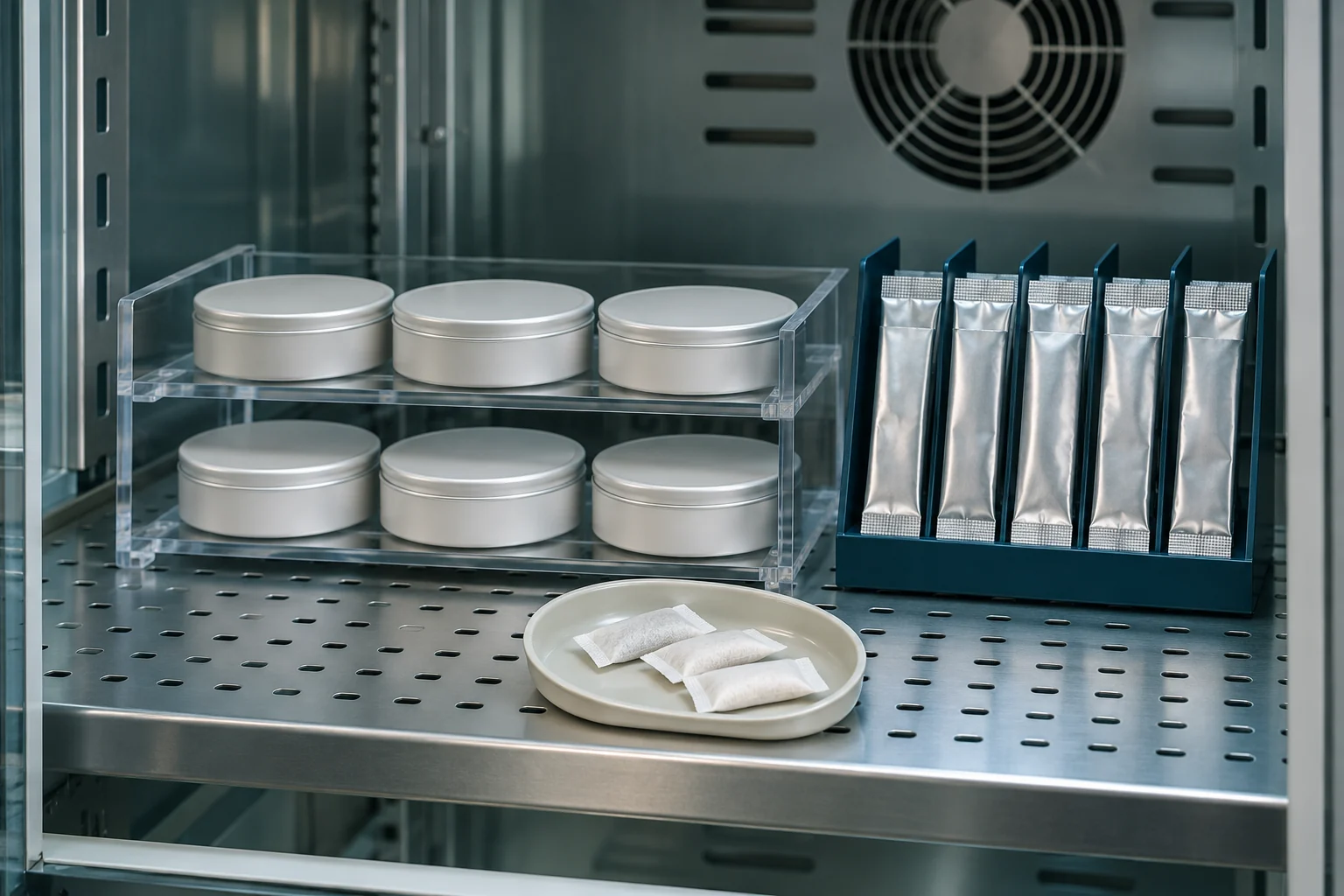
Editorial product illustration.
A shelf-life statement concerns the finished product in its specified pack under stated storage conditions. Ingredient expiry dates, an attractive fresh sample or a successful shipping trial cannot establish that statement on their own. A development project needs a written stability protocol before a long storage period is promised.
Choose representative batches and packs
Identify the formula version, process, batch scale, can or sachet construction, closure and label storage instruction. Explain how the study batches represent commercial production. A change in flavor, humectant, film polymer or barrier material may affect whether earlier evidence can still be used.
Include the final packaging configuration. An ingredient stored in a sealed laboratory bottle does not experience the same moisture, oxygen, light or closure behavior as pouches in a consumer can.
Track attributes that can fail
- Active identity and assay, with appropriate analytical methods.
- Microbiological quality and relevant contaminant controls.
- Moisture or water activity where they inform product behavior.
- Pouch seal integrity or film physical properties.
- Flavor, odor, appearance and usability against defined criteria.
- Closure and barrier performance in the finished configuration.
The chosen limits should have a technical basis. A study that measures only appearance cannot support an active-content statement. A passing assay cannot rule out a pouch seam or packaging failure.
Distinguish real-time and accelerated evidence
Real-time studies follow the proposed storage conditions. Accelerated conditions may help identify failure modes and compare prototypes, but extrapolation needs a justified model and an understanding of the degradation mechanism. Heat or humidity can trigger changes that do not behave proportionally at normal storage conditions.
Published oral-film experiments illustrate formulation-specific stability work. Their reported duration and results belong to those experimental products and methods, not automatically to a new commercial strip. [1] Keep external research separate from the project’s own stability evidence.
Manage the claim as a controlled decision
Assign study ownership, sampling intervals, testing responsibilities and review criteria. Record deviations and trends, including failures that were investigated. Decide how ongoing results will inform commercial stock and whether changes require additional work.
FDA’s dietary supplement cGMP guidance discusses quality specifications and the need for data supporting an expiry date if one is used within that framework. [2] Classification and local requirements must be reviewed before applying that framework to a specific pouch or film.
Questions buyers ask
Can a supplier promise shelf life from the ingredient COAs?
Those records support input qualification. The finished formula and final packaging need relevant stability evidence before a finished-product shelf life is justified.
Does an unchanged flavor prove the active is stable?
No. Sensory acceptance and chemical stability are separate attributes. Appropriate analytical testing is needed for the active.
Does changing the can require a new study?
It requires an impact assessment. If the change affects barrier, closure or product interaction, additional stability work may be needed.
Explore the product specifications
Sources & further reading
- Original study: Compatibility Assessment of a Novel Orodispersible Film Vehicle with Selected Active Ingredients
- FDA: Dietary Supplement CGMP Small Entity Compliance Guide
Sources checked November 7, 2026. External research and guidance are context; they are not test results or authorizations for a Sunova finished product.
Prepared by Sunova Pouches Editorial for B2B product development. Content is reviewed for sourcing and claim scope; it does not establish finished-product efficacy or market authorization.
Our editorial policy