Product development
Herbal and stress-relief pouch development: identity, taste and evidence
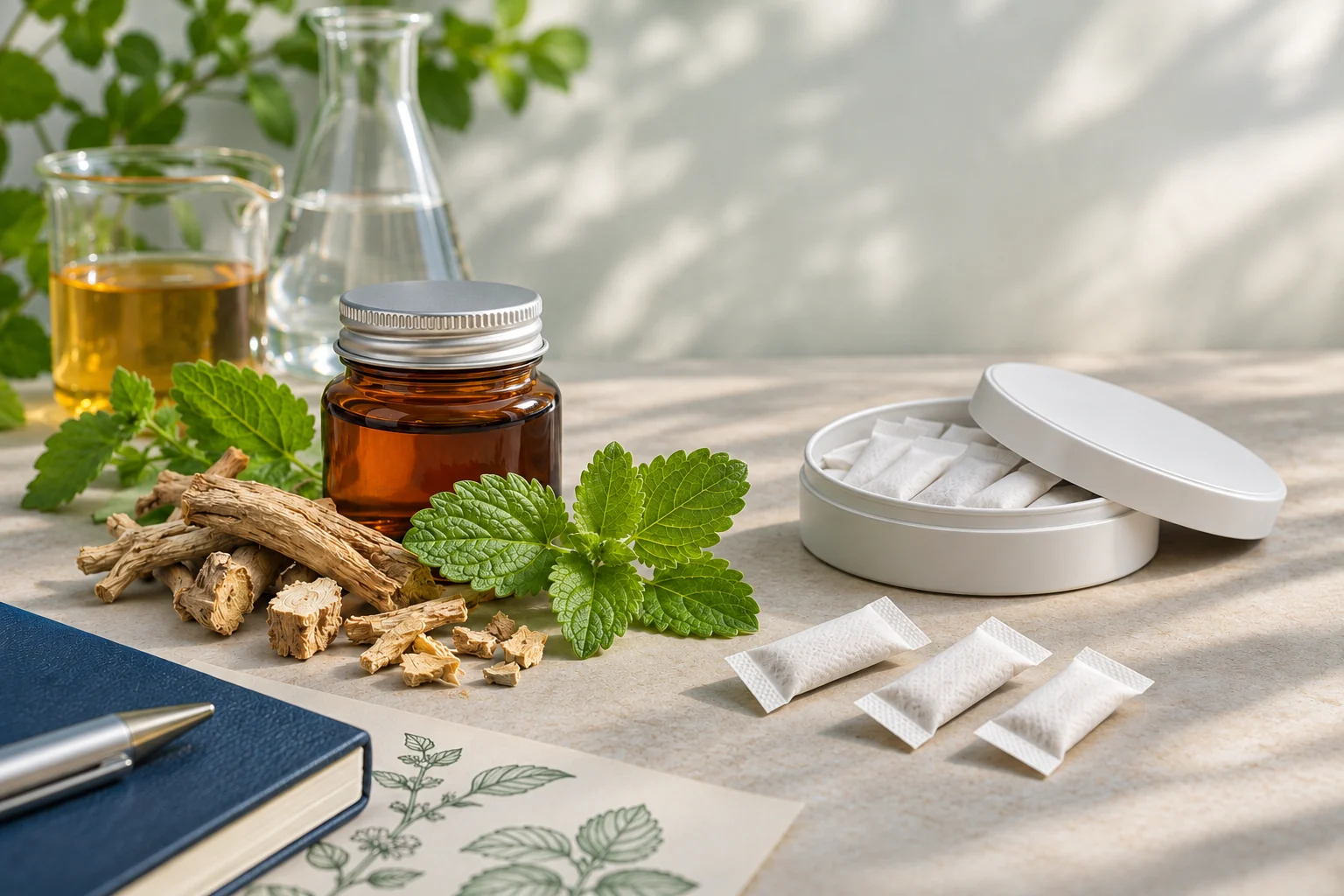
Editorial product illustration.
An herbal pouch project needs two specifications: the botanical material and the finished product. A name such as ashwagandha, lemon balm or rhodiola leaves important questions unanswered, including the plant part, extraction process, marker compounds, carrier and evidence behind the intended statement.
Start with a traceable botanical identity
Record the Latin name, plant part, preparation type and supplier. Where an extract is standardized, identify the marker, test method and basis of the percentage. A root extract and a root-and-leaf extract should not be treated as interchangeable because their front labels share a familiar plant name.
Request the preparation’s full composition. Drying carriers and processing aids can affect taste, flow, moisture and labeling. Contaminant controls should reflect the source and processing of the actual botanical. An attractive specimen photograph cannot establish the identity of the powder supplied to production.
Evaluate the format before selecting a headline claim
Herbal extracts can bring strong bitterness, astringency, color or aroma. Assess the intended active amount alongside the total pouch fill, the mouth-contact experience and the nonwoven material. A concentrated extract may fit physically yet produce an unacceptable sensory profile.
Use prototypes to distinguish the ingredient’s own character from flavor, sweetness and cooling. Keep the evaluation procedure consistent. Increasing the cooling level to distract from bitterness can introduce a new complaint without resolving the underlying formulation.
Read research at the preparation level
NCCIH notes that ashwagandha studies have used varied preparations and often small samples; it also describes safety concerns and possible medicine interactions. [1] That makes it important to match the identity and use conditions of a cited material to the proposed project. It does not establish that a finished oral pouch has the same effect as the preparation studied.
For a stress-positioned concept, write down the exact statement that a buyer expects to use. Evidence review should consider the complete formulation, route and intended audience. FTC guidance requires appropriate substantiation for the health message actually communicated, including implied messages. [2]
Define what must survive manufacturing and storage
Where a marker is used for quality control, decide whether its assay can be performed reliably in the complete pouch. Assess compatibility with the moisture system and packaging, then follow appearance, odor, active or marker recovery and other relevant endpoints in stability work. A botanical’s traditional use does not replace these finished-product checks.
- Botanical identity and preparation details.
- Marker specification and suitable analytical method.
- Full carrier composition and allergen information.
- Sensory acceptance at the proposed formulation level.
- Market classification, warnings and evidence for the final claim.
Questions buyers ask
Can a branded extract be substituted with a generic extract?
Only after reviewing identity, composition, potency, process, evidence and intellectual-property conditions. An equivalent marker percentage alone may not establish equivalence.
Does “adaptogen” prove a pouch reduces stress?
No. The term does not supply finished-product evidence or resolve a market’s labeling rules. Review the exact claim and the specific preparation proposed.
Can several relaxing botanicals be combined without additional review?
The combination needs its own compatibility, safety and claim assessment. Adding individually familiar ingredients can change both the formulation and the intended exposure.
Explore the product specifications
Sources & further reading
Sources checked November 7, 2026. External research and guidance are context; they are not test results or authorizations for a Sunova finished product.
Prepared by Sunova Pouches Editorial for B2B product development. Content is reviewed for sourcing and claim scope; it does not establish finished-product efficacy or market authorization.
Our editorial policy